Just in Time Software - AI's destiny
The software industry is witnessing a fundamental shift. Traditional SaaS applications—with their bloated feature sets, rigid interfaces, and subscription fatigue—are giving way to something more responsive: software that materializes exactly when you need it, tailored to your specific moment.
What Is Just in Time Software?
Just in Time Software represents a paradigm where AI models generate functional applications on-demand in response to natural language prompts. Rather than navigating through pre-built software interfaces, users describe their needs conversationally, and AI delivers purpose-built tools in real time.
Think of it as the difference between maintaining a warehouse full of tools versus having a master craftsman who builds exactly the tool you need, the moment you need it.
This isn't speculation, this is already in the works.
ChatGPT plugins already allow you to manage your Spotify playlists or book a hotel via Booking.com in the chat interface.
Are SaaS applications being faded out?
To understand where software is headed, we need to recognize what's breaking in the current model. For the past two decades, SaaS transformed how businesses consumed software. But the model is showing its age:
Feature Bloat: The average SaaS platform uses only 42% of its available features. Companies pay for comprehensive toolsets while regularly using a fraction of the functionality.
Context Switching: Modern knowledge workers toggle between 10+ applications daily, each with its own interface, logic, and learning curve. This fragmentation costs businesses an estimated 20-30% of productive time.
One-Size-Fits-All: SaaS applications serve thousands or millions of users with identical interfaces. Your specific workflow, industry nuances, and unique requirements get squeezed into generic templates.
Subscription Fatigue: The average small business now manages a dozen SaaS subscriptions. Each demands its own login, billing cycle, and administrative overhead.
Imagine consolidating your software needs into a single conversational interface that generates purpose-built tools on demand. No more app switching. No more paying for features you'll never use. No more adapting your workflow to someone else's product vision.

Why is Just in Time Software the future?
To put things simply: The time is right.
LLM's are advancing at a rapid pace
Models like Claude Sonnet 4.5 and GPT-5 can understand complex requirements, generate production-quality code, and reason about business logic with increasing sophistication. Agentic AI coding has proven, that with the right instructions, an LLM is able to plan, implement and review code at a large scale. What took a development team weeks can now happen in hours—assuming you provide the right context.
Rapid Execution Environments
Cloud infrastructure and containerization allow generated applications to spin up, execute, and scale within seconds—making on-demand software economically viable. Nowadays our software rarely is held back by hardware constraints.
Worth noting: AI inference costs remain significant today, but historically compute cost dropped 10x every few years. What costs dollars today will cost pennies tomorrow, making Just in Time Software increasingly economical as the technology matures.
Software That Adapts to You
Instead of adjusting your business to the available software solutions, the software adjust to you. You don't need the entire Adobe Suite if you just want to retouch and rescale images. Just in time Software gives you the freedom to cherry pick the tools you actually need, created on the fly as you need it.
Helpful AI assistants are just around the corner
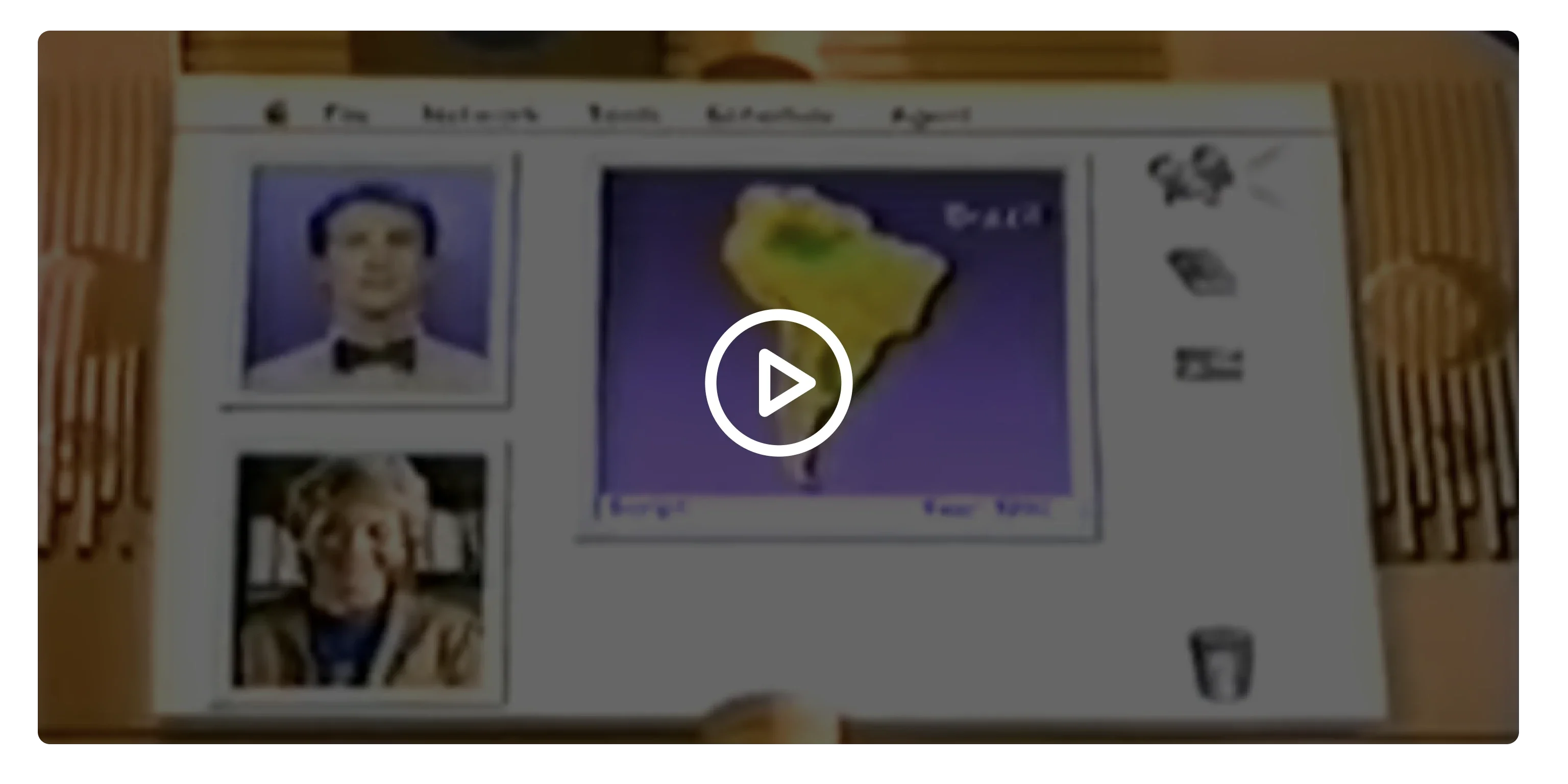
In 1987, Apple released a visionary concept video called the Knowledge Navigator. Set in the fictional year of 2011, it depicted a university professor interacting with a tablet-sized folding computer through a bow-tie-wearing AI assistant named Phil.
The technology seemed impossibly futuristic in 1987. Yet today, nearly every feature in that video exists—Siri, iPads, video conferencing, collaborative documents, voice commands. We're living in the Knowledge Navigator's world.
Where This Leads
Five years from now, software consumption looks radically different:
Conversational Interfaces Dominate
The default interaction model shifts from clicking through menus to describing desired outcomes. Software "surfaces" when needed and recedes when complete.
Micro-Solutions Replace Monoliths
Instead of comprehensive platforms attempting to serve every use case, ecosystems of generated micro-solutions address specific moments with precision.
Context Becomes Competitive Advantage
Companies differentiate through the quality of their context engineering—how well their systems feed AI the right information to generate excellent, aligned solutions.
Preparing for Just in Time Software
Organizations positioning for this shift focus on three areas:
Document Everything: The quality of generated software depends on available context. Comprehensive documentation of business processes, coding standards, and domain knowledge becomes critical infrastructure.
Build Context Systems: Invest in frameworks that intelligently assemble relevant information for AI models. This is the new competitive moat—not the software itself, but the context that ensures generated software aligns with your needs.
Rethink Development Teams: Developers evolve from implementation specialists to AI orchestrators and quality engineers. The question shifts from "can you build this?" to "can you specify this clearly enough for AI to build it correctly?"
The End of SaaS?
Not exactly. Traditional SaaS persists for applications requiring:
Deep state management over extended periods
Complex collaborative features across many users
Highly specialized domain logic built over years
Mission-critical reliability where consistency trumps customization
But for the vast majority of business software—tools that report, visualize, automate, or transform data—Just in Time Software offers a superior model.
Even though the technology is evolving rapidly, making leaps every quarter, adoption and organizational change move slower. This is human nature. Business leaders don't change trajectories overnight—they evolve gradually, laying tracks toward a new path.
Change happens, but it happens at the speed of culture, not technology.
Fun Fact: In January 2025, banks in Germany officially ended support for fax machines. The technology had been obsolete for decades, yet it persisted in infrastructure and processes long after better alternatives existed.
When was the last time you used a fax machine?

Will Vertical SaaS Thrive?
Horizontal SaaS tries to serve everyone = generic CRMs, project management tools, communication platforms. These suffer most from the one-size-fits-all problem. Vertical SaaS, however, operates differently. These platforms encode deep domain expertise that's accumulated over years of working in specific industries. Consider:
Healthcare SaaS that handles HIPAA compliance, medical billing codes, and insurance claim workflows. This isn't just software—it's codified expertise about a complex regulatory environment.
Construction management platforms that understand RFI workflows, submittal processes, and change order management specific to commercial building projects.
Legal practice management systems built around court calendaring rules, conflict checking protocols, and client trust account regulations.
The complexity here isn't in the interface—it's in the hundreds of business rules, compliance requirements, and industry-specific processes these platforms embody. An AI can generate a beautiful timesheet tracker in minutes, but it can't instantly replicate a decade of domain knowledge.
Vertical SaaS becomes the domain knowledge layer that Just in Time Software draws from. The future likely combines both: AI generates custom interfaces and workflows, but those implementations leverage vertical SaaS platforms' deep domain logic through APIs.

Staying ahead of the wave
The lesson? Just in Time Software won't replace SaaS overnight. But the trajectory is clear, and early adopters gain disproportionate advantages while traditional platforms scramble to adapt. At Kyln, we've witnessed this evolution firsthand through our work in AI-assisted development.
Contact us for a free consultation to discover how context engineering can accelerate your development velocity and prepare your organization for the Just in Time Software era.